
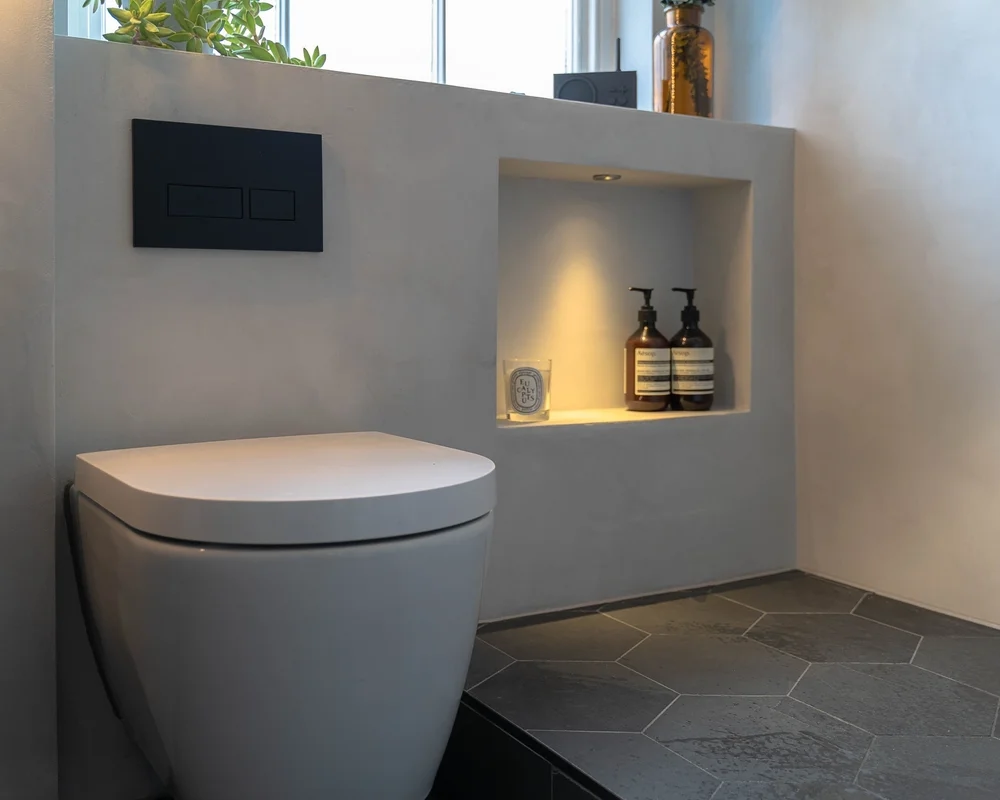
How We Assess Existing Substrates
During our initial consultation, we evaluate your bathroom’s existing surfaces for structural integrity, moisture levels, and bond strength. Microcement requires a completely firm, non-shifting base; we test tiles for hollow spots, check subfloor rigidity, and ensure wall backer boards are fully secured before approving an overlay application.
Conditions That Require Full Demolition
While microcement excels at covering sound surfaces, certain substrate failures mandate a full tear-out:
• Loose, hollow, or cracked tiles that cannot support a stable bond.
• Active sub-surface moisture leaks, rot, or mold within the wall framing.
• Severe floor deflection or structural sagging that causes ongoing movement.
• Improper shower pan pre-slope that leads to standing water.
Repair Solutions vs. Full Tear-Out
Not all minor flaws require complete demolition. Hairline cracks and minor grout line depressions are easily repaired on-site using high-strength epoxy fillers combined with full fiberglass mesh reinforcement. However, when underlying structural framing or original waterproofing membranes are compromised, full demolition is always the safest path to guarantee long-term performance.
Inspection Checklist for Homeowners
Microcement Is a Great Fit If You Want:
Tile Integrity:
Tap your tiles lightly—do they sound solid, or are there hollow/loose spots?
Moisture Status:
Are walls and shower corners completely dry with no active leaks or bubbling drywall behind fixtures?
Height Clearances:
Will an additional ~3mm build-up interfere with door swings, vanity heights, or fixture plumbing extensions?
Drainage Slopes:
In wet zones, does water flow smoothly toward the drain without pooling in corners?
Borderline Cases: How We Determine Feasibility
During our on-site inspection, we frequently evaluate borderline cases—such as hairline substrate cracks or old tile with minor grout depressions. In these scenarios, we apply a full fiberglass mesh embedment coat within a flexible epoxy primer base layer to absorb subtle structural stress.
However, if our moisture meter indicates active sub-wall leaks or if subfloor deflection exceeds strict engineering tolerances, we will always recommend targeted repair or full demolition to protect your investment long-term.